The first pull-up bar I looked at seemed perfect. It was compact, affordable, and had plenty of positive reviews. There was just one problem: it didn’t fit my doorway properly.
That small detail sent me down a surprisingly long rabbit hole.
I started comparing doorway widths, bar lengths, mounting systems, and weight limits.
\Some models were clearly made for standard frames, while others offered enough adjustability to work with wider spaces.
So, rather than making the same mistake twice, I decided to narrow down the options worth considering.
This guide covers some of the best pull up bars for wide doorways and what makes each one stand out.
5 Best Pull Up Bars for Wide Doorways Reviews
There is no single design that works for every wide doorway. After narrowing down the choices, a few models stood out for reasons beyond simple width.
Build quality, how securely the bar sits, and how practical it feels during regular workouts all played a part in making this list.
Quick Comparison: Best Pull-Up Bars for Wide Doorways
Before choosing a pull-up bar, measure the inside width of your doorway. The models below support different frame sizes, so the best option depends largely on how wide your opening actually is.
| Pull-Up Bar | Doorway Width | Weight Capacity | No Drilling | Best For |
|---|---|---|---|---|
| Ally Peaks Pull-Up Bar | 21.65–39.37 in | 500 lb | Yes | Extra-wide doorways |
| Ultimate Body Press XL | 24–36 in | 300 lb | Yes | 36-inch doorways |
| KAKICLAY Multi-Grip | 21.65–36.22 in | 440 lb | Yes | Multiple grip positions |
| DMoose Pull-Up Bar | 27.6–37.4 in | 250 lb | Yes | 37-inch doorways |
| AmazeFan Pull-Up Bar | 21.65–36.22 in | 400 lb | Yes | Compact setups |
1. Ally Peaks Pull-Up Bar — Best Overall for Wide Doorways

The Ally Peaks stood out to me mainly because of how much adjustability it offers.
The 5-level width and 2-level thickness adjustment make it suitable for doorways ranging from 21.65 to 39.37 inches wide, which is particularly useful for wider or slightly awkward frames.
I also liked that it doesn’t require permanent screws, so it can be removed and stored when needed. The 1.7mm thick steel construction and 500-pound weight capacity give it a reassuringly solid feel, while the silicone protection helps reduce contact with the doorframe.
The three grip positions add some versatility for pull-ups and chin-ups, and the bar can also support other bodyweight exercises.
Overall, it feels like a practical choice for anyone specifically looking for a wide-doorway pull-up bar with plenty of adjustability.
2. Ultimate Body Press XL — Best for 36-Inch Doorways

What I liked most about this bar is the elevated design. The bar sits about 1 inch above the door trim and extends roughly 10 inches from the wall, giving a little more room for a comfortable range of motion during pull-ups.
The adjustable ends fit doorways from 24 to 36 inches wide and accommodate molding up to 3.5 inches, making it a solid option for wider frames.
Installation is also refreshingly straightforward since there’s no drilling involved.
The heavy steel tubing supports up to 300 pounds, while the rigid ABS couplers help keep the frame secure during workouts. The high-density foam grips are comfortable enough for longer sets.
I also appreciated the versatility: the same setup can be used for pull-ups, push-ups, dips, and sit-ups.
3. KAKICLAY Multi-Grip — Best for Multiple Grip Positions

The KAKICLAY caught my attention for its combination of grip variety and compact design.
The upper bar has multiple grip positions with angled ends, which made it easier to switch between wider and closer hand placements without feeling locked into one position.
The raised bar also gives taller users a little more room during pull-ups. I particularly liked the updated silicone door protectors, which help keep the frame from getting marked during regular use.
It fits doorways between 21.65 and 36.22 inches wide and supports up to 440 pounds, giving it plenty of range for a wide doorway setup.
The foldable design is another practical touch for homes where storage space is limited.
Suspension straps are included too, adding more options for bodyweight and core exercises.
4. DMoose Pull-Up Bar — Best for 37-Inch Doorways

The DMoose pull-up bar feels like a practical choice for a home setup where drilling into the wall isn’t an option.
The no-screw design makes installation quick, while the wide support bar and padded contact points help keep the bar stable and protect the doorframe.
I liked having four grip zones, wide, narrow, neutral, and underhand, since they make workouts less repetitive.
The raised placement also gives a little more headroom and range of motion during pull-ups and chin-ups. Its three-step adjustment accommodates doorways roughly 27.6 to 37.4 inches wide so that it can work well for wider interior frames.
The heavy-duty steel construction supports up to 250 pounds, and the cushioned grips felt comfortable during longer sets. Overall, it offers a good mix of versatility, straightforward installation, and frame-friendly design.
5. AmazeFan Pull-Up Bar — Best Compact Option
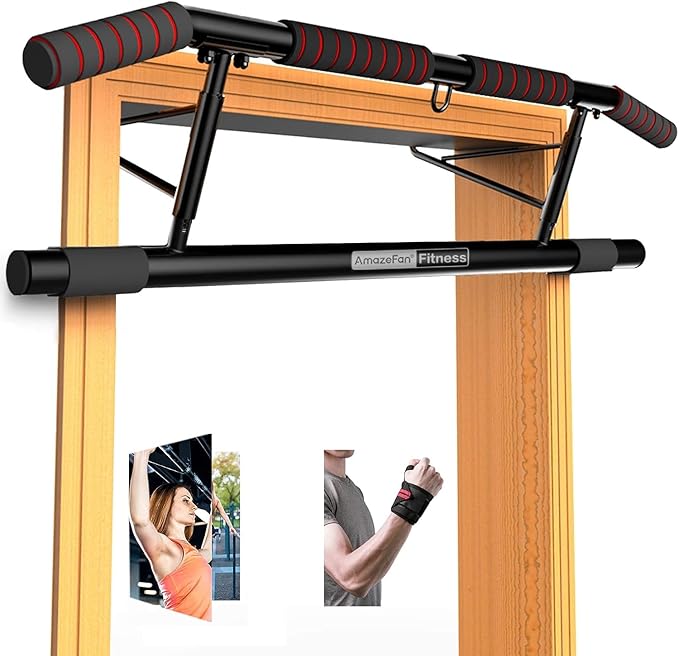
The AmazeFan pull-up bar has a simple design, but the multi-angle grip is what makes it interesting.
The angled handles give a few different hand positions and felt more comfortable on the wrists than a completely straight bar, particularly when switching between grips during a workout.
The soft foam padding also provides a secure hold without feeling overly harsh on the hands. I liked that it hangs onto the doorframe without requiring permanent installation, while the detachable silicone pads help protect the frame from marks.
It fits doorways from 21.65 to 36.22 inches wide and up to 8.27 inches deep, making it suitable for many wider and slightly awkward doorframes.
The bar can also be used for push-ups, sit-ups, and stretching. For a compact home gym setup, it offers useful versatility without taking up much storage space.
What Size Pull-Up Bar Do I Need for My Doorway?
Measure the inside width of your doorway before buying a pull-up bar. A standard model may work for openings around 30 to 32 inches, but wider doorways require more attention to the manufacturer’s maximum supported width.
For a 36-inch doorway, choose a bar explicitly rated to fit at least 36 inches. If your doorway measures 37 to 39 inches, you’ll need an extra-wide model with enough adjustment range.
| Doorway Width | What to Look For |
|---|---|
| 30–32 inches | Most adjustable doorway pull-up bars |
| 33–35 inches | Wide-compatible adjustable bar |
| 36 inches | Model explicitly rated for 36+ inches |
| 37–38 inches | Extra-wide adjustable model |
| 39–40 inches | Check the exact maximum fit before buying |
Width isn’t the only measurement that matters. Check the depth and thickness of the doorframe and the surrounding trim as well. A pull-up bar can support your doorway’s width and still be incompatible with its frame design.
If your doorway is a standard size, see our guide to the best pull-up bars for doorways for more options.
How to Choose the Best Pull Up Bar for a Wide Doorway
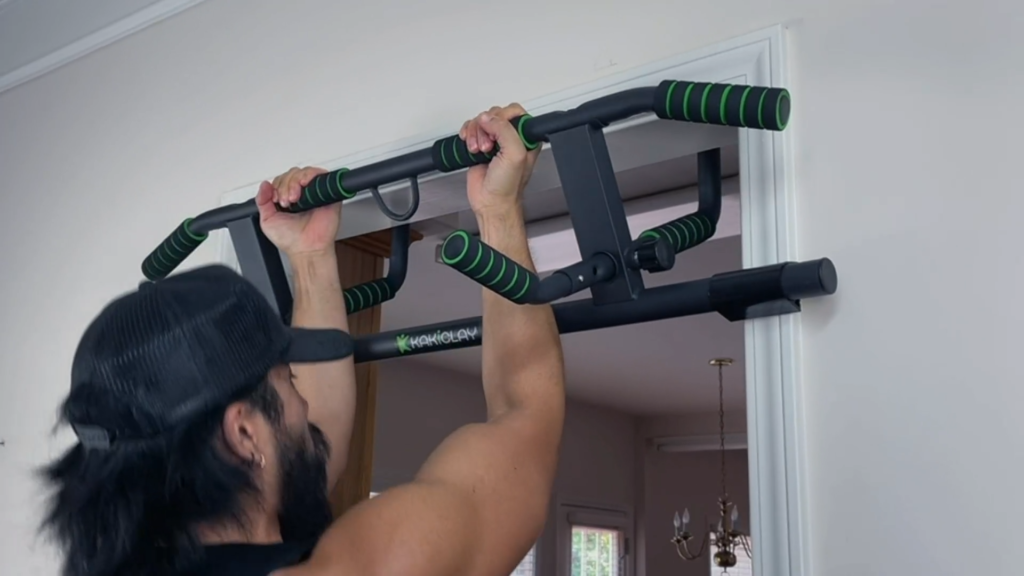
Finding a pull-up bar that fits a wide doorway is about more than simply checking the maximum width. A few other details can make the difference between a bar that feels solid and one that becomes frustrating to use.
Measure the doorway first. Start with the inside width and depth of the frame, then check the product’s recommended dimensions. This is especially important with wider doorways, where even a small measurement mismatch can rule out an otherwise suitable bar.
Check the doorframe depth and trim. Width alone doesn’t determine whether a pull-up bar will fit. Some leverage-style bars need enough trim to rest securely against the frame, while others have limits on frame depth or molding thickness.
Compare all of these measurements with the manufacturer’s specifications before buying.
Check the weight capacity. Look for a bar with a weight limit comfortably above the combined load it will handle. Heavy-duty steel construction, reinforced joints, and sturdy support points can also add confidence during repeated movements.
Consider the grip design. Multiple grip positions can make a doorway bar much more versatile. Wide, narrow, neutral, and angled grips allow different pull-up and chin-up variations while also helping vary hand and wrist positioning.
Look at how it protects the frame. No-drill bars rely on contact points to stay in place, so padding or silicone protection matters. A well-designed support system should distribute pressure rather than concentrating it on a small section of the trim.
Think about installation and storage. A bar that can be installed and removed quickly is convenient for shared spaces or smaller homes. Foldable or compact designs are particularly useful when the doorway needs to remain clear when the workout is over.
Finally, consider the type of training involved. For occasional pull-ups, a straightforward doorway bar may be enough.
For frequent strength workouts, a sturdier model with several grip positions and a higher weight capacity may make more sense.
Frequently Asked Questions
What is the best pull-up bar for a wide doorway?
The best pull-up bar for a wide doorway should match the frame’s width and depth while providing a stable, secure fit. Adjustable doorway pull-up bars are often a practical choice because they can accommodate a wider range of frame sizes.
Can a pull-up bar fit a wide doorway?
Yes, some doorway pull-up bars are specifically designed for wider frames. Many adjustable models accommodate doorways around 36 inches wide or more, but measurements vary by product. Always check the manufacturer’s recommended width and depth before buying.
How wide can a doorway pull-up bar be?
The maximum width depends on the model. Some wide doorway pull-up bars fit frames around 36–39 inches wide, while others are designed for narrower standard doorways. Measuring the inside of the frame is the safest way to determine compatibility.
Are doorway pull-up bars safe for wide door frames?
A properly fitted pull-up bar can be suitable for a wide door frame when the frame is structurally sound, and the bar is installed according to the manufacturer’s instructions. Contact pads, silicone protection, and secure locking mechanisms can also help improve stability.
Do doorway pull-up bars damage the door frame?
Many no-drill pull-up bars use padded or silicone contact points to reduce pressure and prevent scratches or marks. However, the condition and construction of the door frame also matter. Checking the frame before installation is important.
Will a pull-up bar fit a 36-inch doorway?
Yes, but check the manufacturer’s fit range before buying. Several wide doorway pull-up bars are designed for openings of 36 inches or slightly wider. Also check the required frame depth and trim dimensions, since width alone doesn’t guarantee compatibility.
Are there pull-up bars for 40-inch doorways?
Some extra-wide doorway pull-up bars come close to a 40-inch maximum width. For example, the Ally Peaks model covered in this guide is listed for doorways up to 39.37 inches. If your opening is a full 40 inches, don’t assume it will fit; verify the manufacturer’s current specifications before buying.
Are no-drill pull-up bars good for wide doorways?
No-drill pull-up bars can work well for wide doorways when the model is specifically designed for the required dimensions. They are also convenient for renters or home gyms where permanent mounting isn’t practical.
Bottom Line
Choosing the best pull-up bar for a wide doorway ultimately comes down to getting the measurements right.
Doorway width matters most, but frame depth, trim clearance, weight capacity, and mounting design can determine whether a bar actually fits securely.
Measure your doorway first and compare those numbers with the manufacturer’s recommended fit range.
For particularly wide frames, prioritize an adjustable model designed specifically for wider openings rather than trying to make a standard doorway bar fit.
1 thought on “5 Best Pull-Up Bars for Wide Doorways in 2026”